Slab leak service
Slab Leak Detection in Westminster: Pinpointing the Leak Before Anything Gets Cut
Callers usually say it the same way: "I just want to find the leak." That's the right instinct. A slab leak repair is only as tidy as the search before it. Find the spot within a small area and the repair opens one patch of floor, or skips the floor entirely. Guess, and someone ends up chasing water across your tile.
Your call is transferred to a plumbing office that serves Westminster. The transfer can go quiet for a moment, so don't hang up until a person answers.
How a slab leak gets found, stage by stage
- Confirm there's a leak. Every fixture, irrigation zone and appliance goes off. The meter's leak indicator should sit still. If it turns, water is leaving the system. A pressure gauge on a hose bib shows whether pressure drops while the house is shut down.
- Split hot from cold. Closing the cold inlet at the water heater isolates the hot side. If the meter stops, the leak is on the hot side. Houses with a manifold or separate valves let the plumber divide the system further.
- Trace the line. Under-slab lines rarely run where you'd guess. A line tracer, or the layout of the fixtures, maps the route so the listening happens over the actual pipe.
- Listen and image. An acoustic ground microphone picks up the hiss of pressurized water escaping under concrete, and the loudest point narrows the search. A thermal camera shows the heat spread of a leaking hot line through tile or thin flooring. On quiet or deep leaks, some plumbers drain the line and push a harmless tracer gas through it, then detect where the gas escapes.
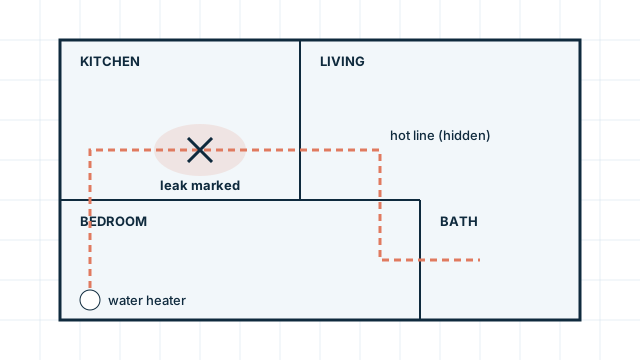
- Mark it. The result is a marked spot on the floor and a plain explanation of what's under it.
Here's the test you can run before anyone arrives: with everything off, watch the small leak indicator on the meter for two minutes. The full method is in the water meter leak test.
Questions to ask about the equipment
Callers ask things like "do you have that imaging equipment" and "make sure he has the proper equipment to find it in the slab." Fair questions. These are worth asking on the phone:
- Which methods will be used on this house: pressure testing, acoustic, thermal, tracer gas?
- How is the spot confirmed before any concrete is opened?
- Does the detection fee count toward the repair if the same company does the work?
- What happens if the first opening is dry?
How close the mark lands depends on the depth of the pipe, the flooring and the background noise. A refrigerator compressor, a pool pump or traffic from Beach Boulevard or the 405 can all compete with a quiet leak. Ask how the plumber deals with that.
What makes a leak hard to pin down
Some leaks give themselves away in minutes. Others take patience. The usual reasons:
- Thick tile set in a mortar bed muffles the sound.
- Carpet and pad soak up heat, hiding a hot line from a thermal camera.
- Two leaks at once send mixed signals.
- Water can travel along the outside of the pipe before it surfaces, so a damp spot may not sit over the leak.
- A very slow leak barely moves the meter and makes little noise.
Where it usually is: hot lines running under kitchens and bathrooms, and lines where they rise out of the slab into a wall.
Drain lines under the slab are a separate search
A slab can also hide drain and sewer pipes. Those aren't pressurized, so they don't hiss. They're tested by plugging the line and filling it with water to see if the level drops, then inspected with a camera. If you've been told your drains failed a test, read failed hydrostatic test and mention it on the call so the right equipment comes.
After the leak is marked
Once the spot is known, there are three common repairs: open the floor and replace the section, reroute the line through the attic, or repipe the whole house if the copper is tired throughout. Warm floors point to the hot water line. If the leak turns out to be between the meter and the house, see water line leak repair. The main slab leak repair page compares the options for Westminster houses.
Before you call, jot down
- Where water shows, if anywhere
- What the meter did with everything off
- Whether a floor spot feels warm
- Roughly how old the house is
- The flooring in the suspect room: tile, wood or carpet
- Whether the house has a manifold or separate shutoffs
A running-water sound helps too. Running water under the floor explains what that sound can tell a leak locator.
Questions callers ask
Does finding the leak mean breaking the floor?
No. The search uses pressure tests, listening equipment and thermal imaging from above the floor. Concrete only gets opened if a spot repair is the chosen fix, and only over the marked spot.
How long does a leak search take?
It depends on the house. A loud hot-line leak under a kitchen can be quick to find. A quiet cold-line leak under carpet takes longer. Ask about timing when you call.
Can the leak be in the yard instead of under the house?
Yes. The service line from the meter to the house runs under the yard and often the driveway. Closing the house's main valve and checking the meter tells you which side the leak is on.
Is it worth locating the leak if I'm going to reroute anyway?
Usually, yes. Knowing whether it's the hot or cold side, and which branch, decides how much of the plumbing needs rerouting.
Talk to a plumber about this leak
Call about a slab leak · (657) 347-3584Your call is transferred to a plumbing office that serves Westminster. The transfer can go quiet for a moment, so don't hang up until a person answers.